欧拉替换 OR 双元法
对于含有根号的不定积分问题,根据对应的形式我们常见的处理手段有三角换元法、根式换元法、双曲换元法等。当然,对于形如 \(\displaystyle \int G(x, \sqrt{ax^2+bx+c})\) 的不定积分,如果根号内的二次式没有等根,那么上面提到的这些方法都无法解决,无法用有理表达式代替,这就需要介绍一种新的方法——欧拉替换法。
第一类替换(\(a>0\) 的情况)
令
\[
\sqrt{ax^2+bx+c}= \color{red}{t-\sqrt{a}\cdot x}
\]
两边同时平方得:
\[
ax^2+bx+c = ax^2+t^2-2\sqrt{a}\cdot tx
\]
消去 \(ax^2\) 项后,得到:
\[
bx+c = t^2-2\sqrt{a}\cdot tx
\]
则 \(x\) 可以用只含 \(t\) 的式子表示,得到如下三个替换式:
第一类欧拉替换
\[
\color{red}{\begin{aligned}
x &= \dfrac{t^2-c}{2\sqrt{a}\cdot t + b}\\[0.5cm]
\sqrt{ax^2+bx+c} &= \dfrac{\sqrt{a}\cdot t^2+bt+c\sqrt{a}}{2\sqrt{a}\cdot t + b}\\[0.5cm]
\mathrm{d}x &= 2\dfrac{\sqrt{a}\cdot t^2+bt+c\sqrt{a}}{(2\sqrt{a}\cdot t + b)^2} \mathrm{d}t
\end{aligned}}
\]
例 1
Example
求积分:
\[
\int \dfrac{\mathrm{d}x}{\sqrt{ax^2+bx+c}} \quad (a>0)
\]
解:常规方法肯定是采用配方,然后根据 \(\Delta\) 的正负性进行分类讨论,运算量较大,这里不展开。下面采用第一类欧拉替换进行求解。
法一:
代入前文中推导的替换式:
\[
\begin{aligned}
\int \dfrac{\mathrm{d}x}{\sqrt{ax^2+bx+c}} &= \int \dfrac{2\dfrac{\sqrt{a}\cdot t^2+bt+c\sqrt{a}}{(2\sqrt{a}\cdot t + b)^2} \mathrm{d}t}{\dfrac{\sqrt{a}\cdot t^2+bt+c\sqrt{a}}{2\sqrt{a}\cdot t + b}}\\[0.2cm]
&=\int \dfrac{2\mathrm{d}t}{2\sqrt{a}\cdot t + b}\\[0.2cm]
&= \dfrac{1}{\sqrt{a}} \int \dfrac{\mathrm{d}(2\sqrt{a}\cdot t + b)}{2\sqrt{a}\cdot t + b}\\[0.2cm]
&= \dfrac{1}{\sqrt{a}} \ln (2\sqrt{a}\cdot t + b) + C\\[0.2cm]
&= \dfrac{1}{\sqrt{a}} \ln (2\sqrt{a}\cdot (\sqrt{ax^2+bx+c}+\sqrt{a}\cdot x) + b) + C\\[0.2cm]
&= \dfrac{1}{\sqrt{a}} \ln (2\sqrt{a}\cdot \sqrt{ax^2+bx+c} + 2a x) + b) + C\\[0.2cm]
\end{aligned}
\]
法二:
事实上,本题采用双元法可以更为优雅地解决:
配方:
\[
\begin{aligned}
ax^2+bx+c &= a\left [ \left (x+\dfrac{b}{2a} \right)^2 + \dfrac{4ac-b^2}{4a^2}\right]\\[0.2cm]
&= \left (\sqrt{a}x+\dfrac{b}{2\sqrt{a}} \right)^2 + \dfrac{4ac-b^2}{4a^2}
\end{aligned}
\]
考虑双元:
\[
\begin{aligned}
p &= \sqrt{ax^2+bx+c}\\
q &= \sqrt{a}x+\dfrac{b}{2\sqrt{a}}
\end{aligned}
\]
则有:
\[
p^2-q^2=\dfrac{4ac-b^2}{4a^2}
\]
即虚元,故满足 \(p\mathrm{d}q=q\mathrm{d}p\),现在对原积分进行化简:
\[
\begin{aligned}
\int \dfrac{\mathrm{d}x}{\sqrt{ax^2+bx+c}} &= \frac{1}{\sqrt{a}} \int \frac{\mathrm{d}q}{p}\\[0.2cm]
&= \frac{1}{\sqrt{a}} \int \frac{\mathrm{d}p}{q}\\[0.2cm]
&\xlongequal{合比定理} \frac{1}{\sqrt{a}} \int \frac{\mathrm{d}(p+q)}{p+q}\\[0.2cm]
&= \frac{1}{\sqrt{a}} \ln |p+q|+C\\[0.2cm]
&= \frac{1}{\sqrt{a}} \ln \left|\sqrt{ax^2+bx+c} + \sqrt{a}x+\dfrac{b}{2\sqrt{a}}\right|+C\\[0.2cm]
\end{aligned}
\]
到这里就做完了,显然两种方法的结果之差一个常数,故等价。
本题采用双元法只需要构造一对虚元,然后运用合比定理就解决了,建议和欧拉替换法一起掌握!
第二类替换(\(c>0\) 的情况)
令
\[
\sqrt{ax^2+bx+c}= \color{red}{xt+\sqrt{c}}
\]
(也可令 \(\sqrt{ax^2+bx+c} = \color{red}{xt -\sqrt{c}}\))
两边同时平方得:
\[
ax^2+bx+c = x^2t^2+c+2\sqrt{c}\cdot tx
\]
消去 \(c\) 并约去 \(x\),得到:
\[
ax+b = xt^2+2\sqrt{c}\cdot t
\]
则 \(x\) 可以用只含 \(t\) 的式子表示,得到如下三个替换式:
第二类欧拉替换
\[
\color{red}{\begin{aligned}
x &= \dfrac{2\sqrt{c}\cdot t-b}{a-t^2}\\[0.5cm]
\sqrt{ax^2+bx+c} &= \dfrac{\sqrt{c}\cdot t^2-bt+a\sqrt{c}}{a-t^2}\\[0.5cm]
\mathrm{d}x &= 2\dfrac{\sqrt{c}\cdot t^2-bt+a\sqrt{c}}{(a-t^2)^2} \mathrm{d}t
\end{aligned}}
\]
例 2
Example
求积分:
\[
\int \frac{\mathrm{d}x}{x+\sqrt{x^2-x+1}}
\]
法一:
由于 \(c>0\),故考虑使用第二类欧拉替换,令:
\[
\sqrt{x^2-x+1} = tx+1
\]
代入上述替换式,得:
\[
\begin{aligned}
\int \frac{\mathrm{d}x}{x+\sqrt{x^2-x+1}} &= \int \frac{2\dfrac{t^2+t+1}{(1-t^2)^2} \mathrm{d}t}{\dfrac{2t+1}{1-t^2} + \dfrac{t^2+t+1}{1-t^2}}\\[0.2cm]
&=\int\frac{2(t^2+t+1)}{(1-t)(t+2)(t+1)^2}\mathrm{d}t
\end{aligned}
\]
设分式分解形式:
\[
\frac{2(t^2+t+1)}{(1-t)(t+2)(t+1)^2}
=\frac{A}{1-t}+\frac{B}{t+2}+\frac{C}{t+1}+\frac{D}{(t+1)^2}
\]
两边同乘分母:
\[
\begin{align*}
2(t^2+t+1)
=&A(t+2)(t+1)^2+B(1-t)(t+1)^2\\
&+C(1-t)(t+2)(t+1)+D(1-t)(t+2)
\end{align*}
\]
代入特殊值求或使用无穷大匹配、模法进行系数求解,得:\(A=\dfrac12,B=2,C=-\dfrac52,D=1\)
于是分解结果:
\[
\frac{2(t^2+t+1)}{(1-t)(t+2)(t+1)^2}
=\frac{\frac12}{1-t}+\frac{2}{t+2}-\frac{\frac52}{t+1}+\frac{1}{(t+1)^2}
\]
故:
\[
\begin{aligned}
I&=\int\left( \frac{1}{2(1-t)}+\frac{2}{t+2}-\frac{5}{2(t+1)}+\frac{1}{(t+1)^2} \right)\mathrm{d}t\\
&=\frac12\int\frac{\mathrm{d}t}{1-t}+2\int\frac{\mathrm{d}t}{t+2}-\frac52\int\frac{\mathrm{d}t}{t+1}+\int\frac{\mathrm{d}t}{(t+1)^2}\\
&=-\frac12\ln|1-t|+2\ln|t+2|-\frac52\ln|t+1|-\frac{1}{t+1}+C
\end{aligned}
\]
代入 \(t=\dfrac{\sqrt{x^2-x+1}-1}{x}\) 即可得到最终结果:
\[
\begin{aligned}
I
=&-\frac12\ln\left| \frac{x-\sqrt{x^2-x+1}+1}{x} \right|
+2\ln\left| \frac{\sqrt{x^2-x+1}+2x-1}{x} \right| \\
&-\frac52\ln\left| \frac{\sqrt{x^2-x+1}+x-1}{x} \right|
-\frac{x}{\sqrt{x^2-x+1}+x-1}+C
\end{aligned}
\]
法二:
本题同样可以采用双元法,计算量会小很多。考虑双元:
\[
\begin{aligned}
p &= x-\dfrac12+\sqrt{x^2-x+1}\\
q &= x-\dfrac12-\sqrt{x^2-x+1}
\end{aligned}
\]
则有 \(pq = -\dfrac34\)
代入原积分得:
\[
\begin{aligned}
\int \frac{\mathrm{d}x}{x+\sqrt{x^2-x+1}} &= \int \frac{1}{p+\frac12}\mathrm{d}\left(\frac{p+q}{2} \right)\\[0.2cm]
&=\frac12\int\frac{\mathrm{d}p}{p+\frac12} + \frac12\int\frac{\mathrm{d}q}{p+\frac12}\\[0.2cm]
&=\frac12\int\frac{\mathrm{d}p}{p+\frac12} + \frac12\int\frac{q\mathrm{d}q}{pq+\frac12q}\\[0.2cm]
&=\frac12\ln \left(p+\frac12\right) + \frac12\int\frac{q\mathrm{d}q}{-\frac34+\frac12q}\\
&=\frac12\ln \left(p+\frac12\right) + \frac12\int \left(2+\frac{6}{2q-3}\right)\mathrm{d}q\\
&=\frac12\ln \left(p+\frac12\right) + \frac12\left[\int 2\,\mathrm{d}q+\int\frac{6}{2q-3}\mathrm{d}q\right]\\
&=\frac12\ln \left(p+\frac12\right) + q+\frac{3}{2}\ln(2q-3)+C\\
\end{aligned}
\]
带回 \(p\) 和 \(q\) 的表达式即可得到最终结果:
\[
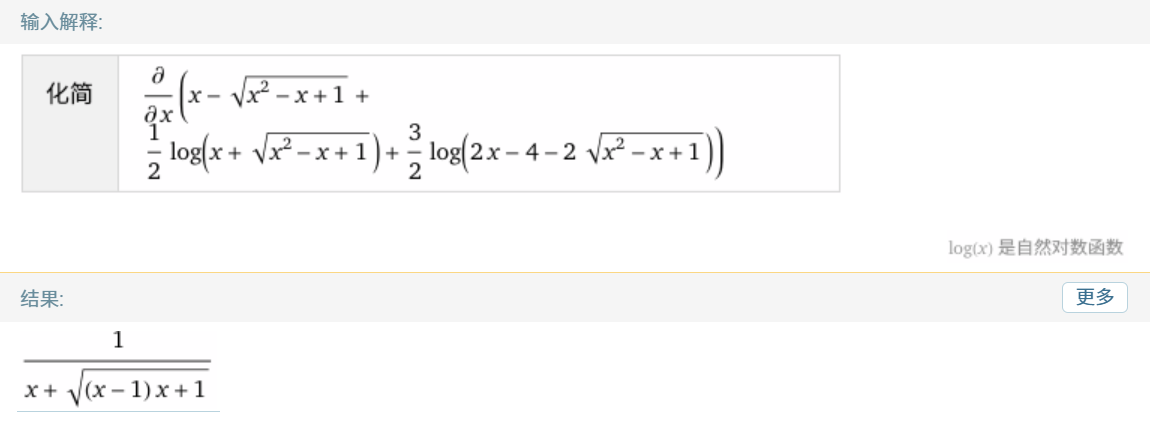
I= x-\sqrt{x^2-x+1}+\frac12\ln\left(x+\sqrt{x^2-x+1}\right)+\frac32\ln\left(2x-4-2\sqrt{x^2-x+1}\right)+C
\]
两种方法的结果是等价的,不信的话可以用软件求导验证一下。
第三类替换(\(\Delta > 0\))
第三类替换适用于 \(ax^2+bx+c\) 有相异的实根 \(\lambda\) 和 \(\mu\),此时可以因式分解为:
\[
ax^2+bx+c = a(x-\lambda)(x-\mu)
\]
\[
\sqrt{ax^2+bx+c}= \color{red}{t(x-\lambda)}
\]
两边同时平方得:
\[
a(x-\lambda)(x-\mu) = t^2(x-\lambda)^2
\]
约去 \((x-\lambda)\) 后,得到:
\[
t^2x-ax = -a\mu+\lambda t^2
\]
则 \(x\) 可以用只含 \(t\) 的式子表示,得到如下三个替换式:
第三类欧拉替换
\[
\color{red}{\begin{aligned}
x &= \dfrac{\lambda t^2-a\mu}{t^2-a}\\[0.5cm]
\sqrt{ax^2+bx+c} &= \dfrac{a(\lambda-\mu)t}{t^2-a}\\[0.5cm]
\mathrm{d}x &= 2\dfrac{a(\mu-\lambda)t}{(t^2-a)^2} \mathrm{d}t
\end{aligned}}
\]
例 3
Example
求积分:
\[
\int \frac{\mathrm{d}x}{x+\sqrt{x^2-5x+6}}
\]
法一:
对被积函数的分母中根号内的二次式进行因式分解得:
\[
x^2-5x+6 = (x-2)(x-3)
\]
令 \(a=1\),\(\lambda=2\),\(\mu=3\) 代入替换式得:
\[
\begin{aligned}
\int \frac{\mathrm{d}x}{x+\sqrt{x^2-5x+6}}
&=\int \frac{\dfrac{2t\mathrm{d}t}{(t^2-1)^2}}{\dfrac{2t^2-3}{t^2-1}-\dfrac{t}{t^2-1}}\\
&=\int \frac{2t}{(t^2-1)(2t^2-t-3)}\mathrm{d}t \\
&=\int \frac{2t}{(t-1)(2t-3)(t+1)^2}\mathrm{d}t \\
&=\int\left[\frac{1}{50(t+1)}-\frac{1}{2(t-1)}+\frac{24}{25(2t-3)}-\frac{2}{5(t+1)^2}\right]\mathrm{d}t \\
&=\frac{2}{5}\cdot\frac{1}{t+1}+\frac{1}{50}\ln(t+1)-\frac{1}{2}\ln(t-1)+\frac{12}{25}\ln(2t-3)+C
\end{aligned}
\]
将 \(t=\sqrt{\dfrac{x-3}{x-2}}\) 代入最终结果为:
\[
\begin{aligned}
\int \frac{\mathrm{d}x}{x+\sqrt{x^2-5x+6}}
&=\frac{2}{5}\big(x-2-\sqrt{x^2-5x+6}\big)
+\frac{1}{50}\ln\left(\frac{\sqrt{x^2-5x+6}}{x-2}+1\right) \\
&\quad -\frac{1}{2}\ln\left(\frac{\sqrt{x^2-5x+6}}{x-2}-1\right)
+\frac{12}{25}\ln\left(\frac{2\sqrt{x^2-5x+6}}{x-2}-3\right)+C
\end{aligned}
\]
法二:
同样可以采用双元法:
首先对根号内的二次项进行配方:
\[
x^2 - 5x + 6 = \left(x - \frac{5}{2}\right)^2 - \frac{25}{4} + 6 = \left(x - \frac{5}{2}\right)^2 - \frac{1}{4}
\]
考虑双元:
\[
p = x - \frac{5}{2} + \sqrt{x^2 - 5x + 6}
\]
\[
q = x - \frac{5}{2} - \sqrt{x^2 - 5x + 6}
\]
则有 \(pq = -\dfrac{1}{4}\),代入原积分得:
\[
\begin{aligned}
\int \frac{\mathrm{d}x}{x+\sqrt{x^2-5x+6}} &= \int \frac{1}{p+\frac52}\mathrm{d}\left(\frac{p+q}{2} \right)\\[0.2cm]
&=\frac12\int\frac{\mathrm{d}p}{p+\frac52} + \frac12\int\frac{\mathrm{d}q}{p+\frac52}\\[0.2cm]
&=\frac12\int\frac{\mathrm{d}p}{p+\frac52} + \frac12\int\frac{q\mathrm{d}q}{pq+\frac52q}\\[0.2cm]
&=\frac12\ln \left(p+\frac52\right) + \frac12\int\frac{q\mathrm{d}q}{-\frac14+\frac52q}\\
&=\frac12\ln \left(p+\frac52\right) + \int\frac{2q}{10q - 1}\mathrm{d}q\\
&=\frac12\ln \left(p+\frac52\right) + \int\left(\frac{1}{5} + \frac{1}{5(10q - 1)}\right)\mathrm{d}q\\
&=\frac{1}{2} \ln \left( p + \frac{5}{2} \right) + \frac{1}{5}q + \frac{1}{50} \ln \left| 10q - 1 \right| + C\\
\end{aligned}
\]
最后,把 \(p\) 和 \(q\) 的代数式替换回 \(x\),得最终结果为:
\[
I = \frac{1}{5}x - \frac{1}{5}\sqrt{x^2 - 5x + 6} + \frac{1}{2} \ln \left| x + \sqrt{x^2 - 5x + 6} \right| + \frac{1}{50} \ln \left| 10x - 26 - 10\sqrt{x^2 - 5x + 6} \right| + C
\]
总结
至此,欧拉替换的三种形式就都介绍完了,在做题时可以根据对应形式选择合适的替换方式。就以例 3 为例,我只是为了展示第三类欧拉替换的用法,但是并不代表例 3 只能用第三类欧拉替换做,事实上,例 3 的 \(a=1>0\),\(c=6>0\),因此前两类欧拉替换也都是可以解决的,读者可以自行尝试。
另外值得一提的是,欧拉替换法固然是一种通法,但是也存在计算量大等缺点。毕竟双元法创始人 虚佬 曾言“欧拉替换的目的并不是计算,只是为了给出一个理论上能转换根式的例子”,他提出的双元理论也为这类题提供了全新的视角。当然双元法的应用绝不局限于此,感兴趣的朋友可以去他知乎主页学习。
搜一搜